
Randolph County Most Wanted Status
Here is the plain truth: Randolph County has no verified public most-wanted list and no verified warrant-search portal. The one county lead that exists is an old Sheriff's web address for a wanted page. That address proves nothing about a list today. It shows no names, no photos, no entry count, and no update schedule. Its absence does not mean no warrants exist. It simply means the old address cannot be treated as a live Randolph County wanted roster.
Start with the Randolph County departments directory, then call the Sheriff's Office or the court clerk handling the case. Ask which warrant facts can be shared with the public. A real answer has to come from the office with authority over the record, since a warrant can be served, recalled, or quashed at any time without an old web page changing with it.
The historical Sheriff most-wanted address is kept here only as a source lead, not as a current list of people or warrants.
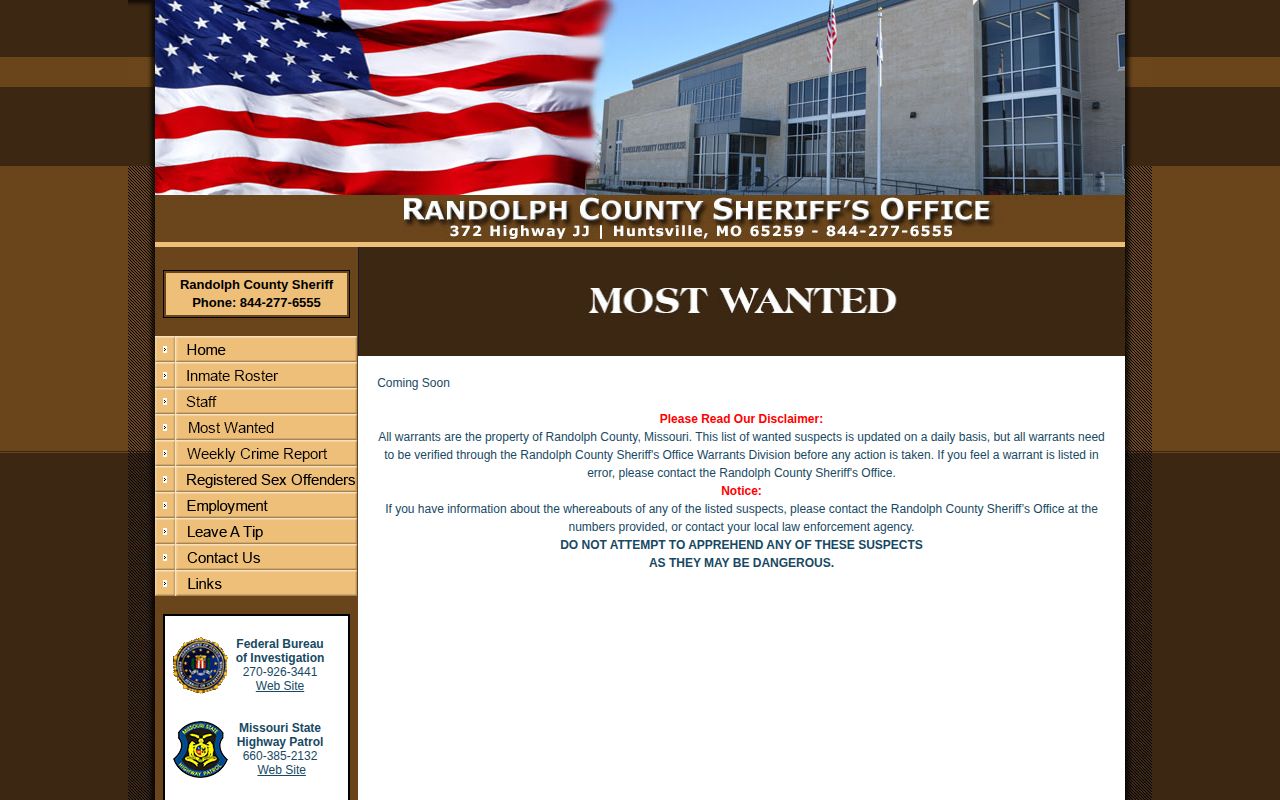
Its capture shows exactly why an official, live-status check is essential before relying on any Randolph County wanted information.
Record status matters. A wanted notice concerns an alleged court or law-enforcement status. It is not a booking record, and it is not proof that a person committed an offense.
Randolph County Wanted Listing Fields
No current list could be verified. That leaves every ordinary listing detail for Randolph County unknown. Supplying names, photos, charges, rewards, or posting habits from a template would mislead readers. The table below describes the fields a verified future listing might contain, while making clear that none of them should be assumed to exist today.
| Possible listing field | Randolph County status |
|---|---|
| Name or alias | Unknown. No current public Sheriff list was verified. |
| Photograph or physical description | Unknown. No current photo policy or photo-bearing list was found. |
| Warrant basis or case reference | Unknown. A court or Sheriff confirmation would identify only public facts. |
| Issue date or current status | Unknown online. Ask whether a warrant is active, recalled, served, or resolved. |
| Reward, anonymity, or posting cadence | Unknown. No verified reward, anonymity, or recurring feature was located. |
A verified listing would still need a date, a source, and an official status check before anyone relies on it. Remember that a booking after an arrest is a separate event. The jail intake record may show that a person entered custody, while the court file holds the later outcome.
Unknown does not mean zero. It only means Randolph County's publication of that field could not be verified. Borrowing a photo, name, charge, or reward from another county's list would be a mistake. If a Sheriff's employee confirms a public page has returned, view it directly, note the date, and let the responsible office speak to any status change.
Note: Never infer a current Randolph County warrant from a missing or stale listing field.
Using Randolph County Wanted Records
Official verification beats browsing. That is the practical rule for Randolph County wanted records. The legacy page can be checked manually as a historical lead, but it cannot be used to name a currently wanted person. When an agency tells you public wanted information exists, write down the source, its date, and the exact status given. Do not circulate an unconfirmed name, image, or claim.
- Open the current county departments directory and confirm the appropriate Sheriff or court contact before relying on any older link.
- Ask whether the agency maintains a current public wanted list and whether a particular public listing can be confirmed.
- Record the office, the date of the response, and any case or court reference the office says is public.
- If an apprehension may already have occurred, use the county’s booking-record and custody route to ask about a current intake record rather than assuming the wanted status remains active.
- Send sightings or safety information to law enforcement. Never contact, follow, confront, or try to detain the person yourself.
Public information shifts fast. A list, where one exists, is selective. A warrant inquiry concerns one person and one specific status. The Sheriff, the clerk, or the issuing court is the source that can explain whether a public answer is available.
Checking a Randolph County Warrant
For a specific warrant question in Randolph County, contact the Sheriff's Office or the right court clerk. Give the person's full legal name plus any identifiers the office requests. This helps you avoid a mistaken match. Ask whether staff can confirm the issuing court, case number, warrant type, issue date, and whether the matter is active, recalled, served, or resolved. Keep your request focused on public record status.
Missouri Case.net can help you locate a court case. It is not a complete Randolph County warrant database. Compare the county, court, case number, and filing date rather than treating a name result as a warrant answer. If no court file turns up, the clerk can explain the next lawful public-record route.
- Begin with the Randolph County Sheriff’s Office at (660) 277-5095 or the court clerk connected with the known case.
- Provide the full name and only the identifiers the office requests for accurate matching.
- Ask for the issuing court, case reference, warrant category, issue date, and current public status.
- Check the related Case.net docket for the later court events, not merely the original charge.
- If the question concerns the person named in the warrant, contact an attorney or the court for lawful direction.
Safety callout. Do not visit a law-enforcement office to test a suspected warrant and do not approach a wanted person. Call 911 for immediate danger; use the Sheriff or court for non-emergency status questions.
A name-only web search invites trouble. It can return false matches, old articles, or records from a different Missouri county. Having the office compare a full name against its own identifiers is far safer than piecing together a possible warrant from headlines or secondhand pages. Anyone personally affected should work through an attorney or the court rather than an informal online answer.
Randolph County Warrant Types
Warrant terms carry general meanings. The court's own wording controls in a real Randolph County case. An arrest warrant generally authorizes an arrest tied to a suspected offense. A bench warrant is different. It usually relates to a court matter, like a missed appearance or a failure to follow a court instruction. Neither label can be confirmed from an unverified web listing.
| Term | General meaning | Randolph County confirmation |
|---|---|---|
| Arrest warrant | A court-authorized arrest tied to an alleged offense or case. | Ask the Sheriff or issuing court for the current public status. |
| Bench warrant | A court-issued warrant commonly connected with a case or required appearance. | Ask the clerk or issuing court which facts can be confirmed. |
| Served, recalled, or resolved | A status change that can make an old listing inaccurate. | Only the responsible office can provide a current answer. |
A name can show up in a booking roster yet never appear on a most-wanted page. The reverse happens too. Warrants and custody records live in separate systems, and those systems update on separate schedules. Treat them as two different answers rather than one combined file.
Status words carry precise meanings. "Active" means the warrant stands right now. "Served" means someone acted on it. "Recalled" means the court pulled it back. Each status belongs to a specific office on a specific date, so capture both when you look. For questions, the court clerk handles docket events. The Sheriff's office handles custody and warrant-status inquiries. No third-party site can substitute for the court's own record.
Note: Match a warrant response to a docket entry using the exact court and case details.
Tips for Randolph County Wanted Reports
The community links for Randolph County include a tips phone number. That's about all they promise. Nothing in the published material guarantees anonymity, a cash reward, or a fast reply. A tip line is a channel for useful information headed to law enforcement, nothing more. It won't confirm a warrant for you. It also shouldn't be dressed up as an official most-wanted program.
Verified Randolph County Tip Lead
Randolph County tips line
660-269-TIPS (8477)
Use 911 when there is immediate danger.
If you call dispatch, share what matters. Give the location, the time, a direction of travel, and a description, but only when it's safe. A tip should never become your own private investigation. Your call can still help even without a case number or access to a public wanted list.
Randolph County Alerts and Bookings
Randolph County has no verified Sheriff's jail app and no routine booking-photo social feed. What it does have is the CivicReady alert registration, an emergency and community-notification service. It is not a warrant list, a custody tracker, or a booking-photo source. Signing up for those alerts won't tell you whether a warrant exists or whether anyone is sitting in the Randolph County Jail.
Need a Moberly report or a dispatch follow-up? The published Moberly Joint Communications route is 660-263-0346. That number handles non-life-threatening matters and report-copy follow-up. It is not an emergency line, and it is not a booking source. The state's MOVANS/VINE service may send custody-status notifications for an individual result, though it stops short of a full Randolph County booking feed.
Three different records get confused all the time, so keep them apart. A wanted status points to an alleged warrant. A booking happens at jail intake. A court disposition tells you what the case became later. For current facts, check with the Sheriff, the issuing court, and the docket.
Ask the right question first. If it's about a recent arrest, find out whether the person is in custody and when the booking occurred. Court case? Request the docket or case reference. Warrant? Ask the issuing court or Sheriff whether a public status answer exists. Sorting your questions this way keeps a community alert, a media report, or an old web address from being mistaken for a live official record.